
Truths We Could Live With
Writing about my mother with her looking over my shoulder.

I recently read the following essay at a conference on Creative Nonfiction at The University of Iceland. The essay was translated into Icelandic and published in an Icelandic literary journal. Originally, it appeared in Joy Castro’s anthology, Family Trouble: Memoirists on the Hazards and Rewards of Revealing Family.
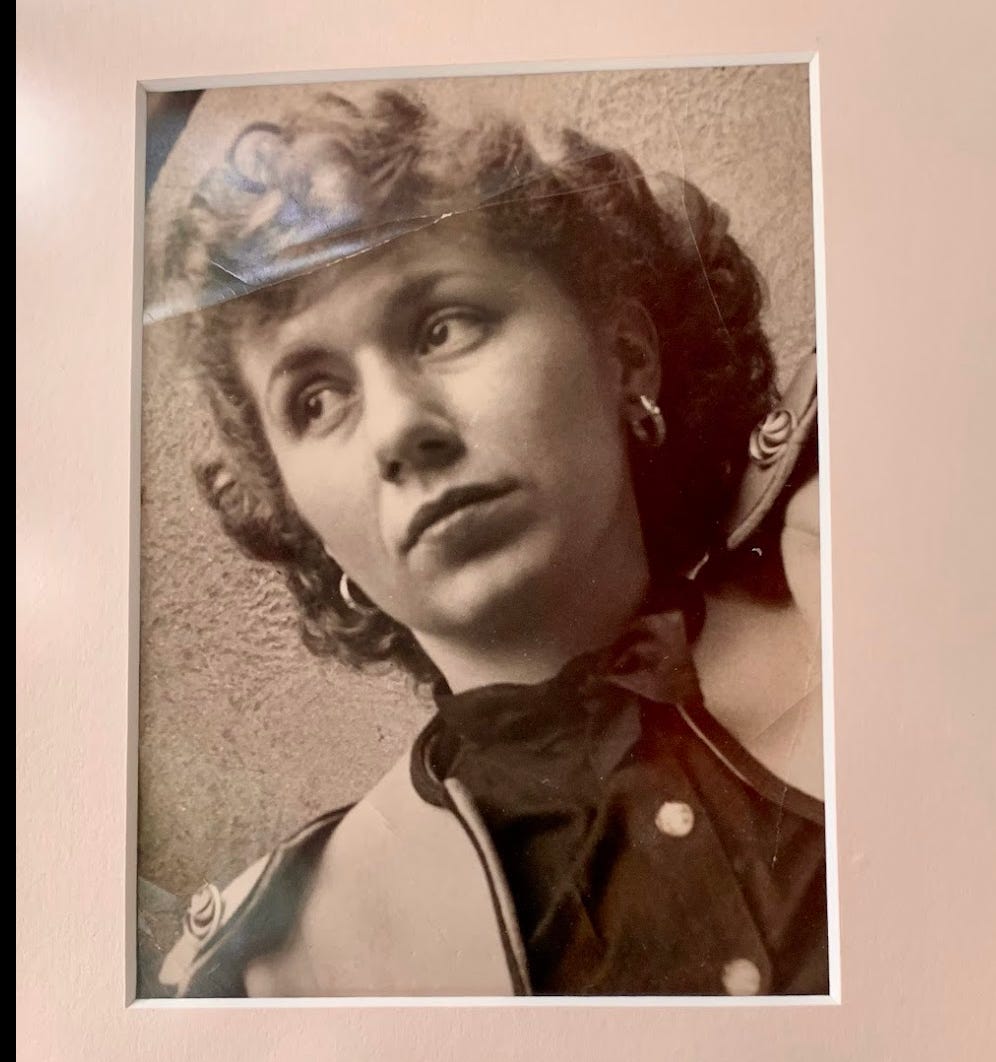
Although my mother, Elaine Gottlieb, was a writer and wrote occasionally about me, she never wanted me to write about her. Until she told me so, I never imagined the possibility that she would forbid me. She was a short story writer and sometime novelist who, in her youth, had been one of the most promising writers of her generation, appearing in The Best American Short Stories 1946, and counting among her ardent supporters John Crowe Ransom, the famous editor of The Kenyon Review. But her career waned over time: marriage to my father, his press, their translations of Isaac Bashevis Singer's work, my brother, my sister, me-we all chipped away at her time and energy and eventually her promise.
I grew up as a character in my mother's short stories-I even suggested one story to her. When I was eleven, I dreamed of a lizard doing yoga and told my mother she should write a story about it. She did, in her own fashion. She wrote a story about an eleven-year-old boy who, among other things, imagines a lizard doing yoga. The story, "The Lizard" was dedicated to me, published in The Southern Re view and reprinted in The 0. Henry Prize collection.
We were allies then.
Still, I felt uncomfortable when I'd occasionally read a short story in which a thinly veiled me was one of the characters and I'd read about some awful trait of mine that my mother had taken note of. A kind of literary scolding . There were many. When I complained, she’d say, “Honey, it’s fiction. No one’s going to know it’s you." But of course, that itself was the fiction. I knew it was me and knew that my mother was recording for posterity my more unpleasant traits.
When I started writing stories of my own, my mother was fine with that. Oh, she had twinges of jealousy, but they were overridden by pride. Her own stories were published less and less frequently as literary tastes inevitably changed and she could no longer be described as "promising." But we continued to support one another, and I helped her publish her last short story, a beautiful piece called "The Dance at the End of the War," about her time at Black Mountain College studying with painter Robert Motherwell [Note: I’ve republished “The Dance at the End of the War” in this Substack. You can read it in the archives.]
All was fine until I decided to write a memoir about my older sister Nola, diagnosed with schizophrenia, who had died of a prescription drug overdose at the age of twenty-five, when I was fifteen. My mother was horrified that I wanted to write about our family as nonfiction. "Why can't you fictionalize it?" she asked. Funny, but what she considered fiction was closer to memoir with the names simply changed. I didn't want to change the names.
The tension this caused I simply incorporated into the book about my sister, Nola: A Memoir of Faith, Art, and Madness, which was in some ways less about my sister than about this very topic: what we have permission to write about and what we don't. As I come from a family of writers, I decided to use the various texts my family produced to triangulate the truth of my sister and my family's life. I incorporated an autobiography my sister wrote in the last year of her life, some court documents, a short story by my mother that was essentially a story a clef (to coin a term) about my sister and myself, and a short story I wrote about the night before my sister died. Thisstory had appeared in my debut story collection. My goal was to show that fiction or nonfiction didn't matter-the pain contained in either could be equally visceral and real. When my mother complained on the phone that she would have to become a hermit after I completed my book, I went to my study and recorded the conversation nearly verbatim. I suppose there was an inherent brattiness in such a move, but I felt it was justified, even crucial.
My mother disagreed.
With her psychically looking over my shoulder as I wrote, I nonetheless wrote without showing her a word. I hardly showed it to any one. I knew that I needed to write it to myself first and then I could let it out into the world. I struck a deal with her. I told her that I would show her the book after it was completed and that she could give me her suggestions and criticisms, which I would consider the way I'd consider the suggestions of an editor.
And so, when I finally completed the book, I had to fulfill my promise, but it was not as easy as that. In the time between starting the book and completing it, my mother developed severe glaucoma and macular degeneration. In order to keep my word, I had to read her the book chapter by chapter. So every night for two weeks, I drove to her apartment and read to her. While I knew that she wouldn't be pleased by all of it-the stigma of mental illness, the keen pain she felt at the loss of her beloved daughter, and the revelation that my mother had not been married to my sister's father, another stigma in my mother's eyes-I gambled that her pride in me as a writer and her love for me would win out.
But there was one section early on that I did not want to read to her. My father had died of a massive heart attack at the age of fifty-one. I was seven and my brother was five years older, and we were bundled to a friend's house that night while my mother-in the company of my sister, Nola, and my mother's good friend, the poet Patricia Goedicke - drove the fifty miles from Athens, Ohio, to Columbus where my father was in the intensive care unit. Our family physician, Dr. Goldsmith, grimly told my mother in private that my father wouldn't last the night and that she shouldn't return to Athens. My mother didn't listen. She had a congenital hearing problem and wore hearing aids in both ears for much of her life. But this was an emotional inability to hear, not a physical one. When she returned to the waiting room, Patricia and Nola awaited the prognosis. "Cecil is going to be fine," my mother told them. "Dr. Goldsmith said we should go home and get some rest and come back tomorrow." They drove back to Athens together.
In the middle of the night, Patricia was awakened by a phone call. It was Dr. Goldsmith. "Where's Elaine?" he said. "Cecil is fading fast." Patricia raced over to our house and rang the doorbell. There was no answer, and she rang again and again. She peeked in the large picture window at the front of the house and spied my mother sitting in a chair with a drink in her hand, lights ablaze, her hearing aids apparently turned off.
To me, there was no more emblematic story of the way my mother handled crisis and ugly truths. She fictionalized them, as we all do to a certain extent. She made them into truths she could live with.
When Patricia told me this story, I knew I had to use it, but I also knew that there would arrive for my mother and me a moment when we would have talk to one another about the past, frankly and openly, rather than fictionalize or bury it. This was that moment, when I faced my nearly blind, nearly deaf mother, the object of so many restorative operations that failed really to restore anything. I stopped reading.
I knew that I could skip right over that passage and she wouldn't notice. Doing this would spare her some pain. But I also knew it would break my promise. I knew that it would undermine what I wanted to get across-to myself and to her. I started reading again. I remember a deep silence after I finished. She sat for a while and so did I, barely moving, the way we used to wait on the porch of my grandmother’s house in Long Island in the flight path of JFK for a jet to pass overhead before we could be heard again over the roar. Finally, she spoke. "That's not what I remember."
I'm not sure how I responded. If I know myself-and that's some times debatable-I tried to assuage my guilt by directing it outward and showing compassion for her. I probably told her how understandable her reaction was. I'm sure that part of my reaction was self-serving, the plea of a somewhat spoiled child: please don't make me take it out. I say that part of my reaction was self-serving, but not all of it. I did feel tremendous sadness over this episode and for her suffering. I had been so young when my father died. When I was finally brought home from our friends’ house afterward, my first sight was my mother sitting in that same chair in which Patricia had found her. But now she wasn't alone. She sat there red-faced and in a daze, people milling around her, murmuring but saying nothing directly to her. When she saw me, she reached out her arms, and I rushed upon her and burst into tears, burying myself in the cushioned chair and her arms, given over fully to the grief of seeing my mother so alone in this room full of people. There was nothing else to do or say then.
When my sister died eight years later, my mother asked if I would like to talk to someone about it, and if I had been older, I might have said, Yes, I would like to talk to you about it. But I didn't have the self-knowledge to make that request. I was making it now.
I had written a book to make the request apparent. With my mother, there was no other way. Books, after all, were the language of our family, the only way we made ourselves fully known to one another.
I love this recollection, this content, and the beautiful writing. I felt it very deeply and it opened up some new thinking about how to communicate through this form when other things don’t work. Thank you, Robin.
I can just hear you telling this story about your mom and you, about the way we each fictionalize what happens in our family. I mean I can hear your voice, the way you inject humor in the saddest narrative, your choice of words, the wonderfulness of your choice of words. I loved every single word in this piece. We who write memoir all write with our family members looking over our shoulder.